


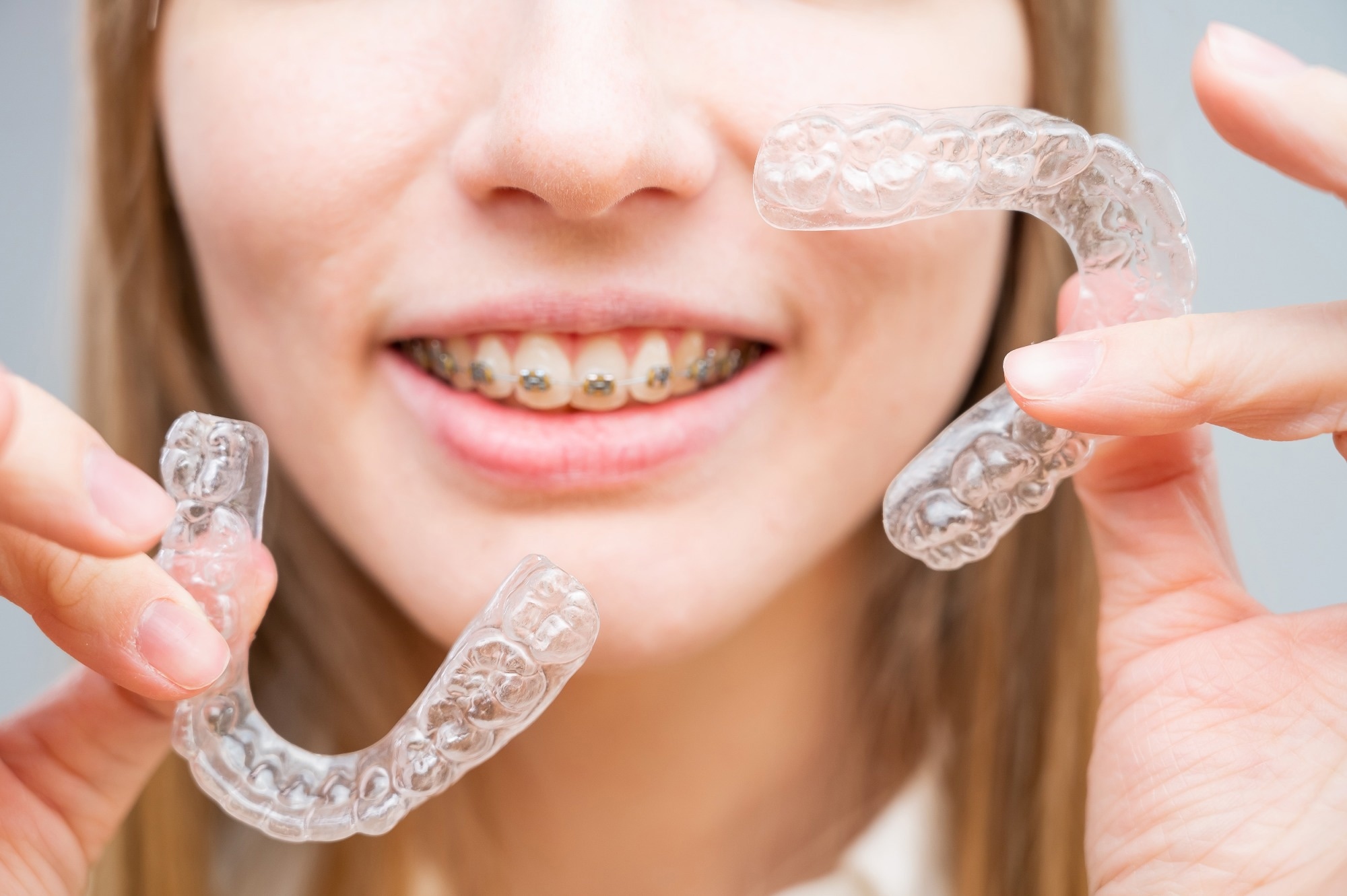
A six-month randomized study reveals how choice of orthodontic appliance shapes oral bacteria, periodontal health and oxidative stress, showing that the choice of fixed braces or clear aligners can affect long-term oral health outcomes.
Study: Comparison of the effects of clear aligners and fixed appliances on oral microbiota and reactive oxygen species: a prospective study. Image credit: Reshetnikov_art / Shutterstock.com
A recent study published in Frontiers in Cellular and Infectious Microbiology compared the effects of clear aligners and fixed appliances on oral microbiota and oxidative stress in the oral cavity.
Fixed dental appliances versus clear aligners
Fixed dental appliances are designed to provide precise control of tooth movement using abutments attached directly to the enamel surface, which are attached to bands and archwires. Despite their widespread use as orthodontic appliances, the design of fixed dental appliances creates protected pockets of plaque that are difficult to clean, thereby increasing the risk of dental caries and gingivitis.
Fixed dental appliances may promote colonization by cariogenic and periodontal-associated bacteria, as suggested by previous studies, and may contribute to changes in the oral microbiome associated with inflammation. This device-induced oral dysbiosis contributes to excessive production of reactive oxygen species (ROS) by pathogenic bacteria, which further exacerbates inflammation.
Compared to traditional braces, clear aligners are thermoplastic devices created through computer-aided design (CAD) and computer-aided manufacturing (CAM) that have been shown to improve patient comfort and aesthetics during treatment. Additionally, clear aligners are associated with a lower risk of inflammation and oral dysbiosis.
Clear aligners must be worn for at least 22 hours a day. However, they are removable, allowing for a thorough cleaning of the teeth. However, continued use of clear aligners can impede the free flow of saliva and promote plaque build-up.
Prospective randomized comparison of aligners and fixed appliances
The current study included 24 patients who were randomly assigned either clear aligners or fixed appliances.
At baseline, saliva, supragingival plaque, and gingival fluid (GCF) samples were collected to assess the oral microbiome, caries-associated microbial profile, and periodontal and gingival inflammation, respectively. Periodontal health was assessed using plaque index (PI), gingival index (GI), probing depth (PD) and bleeding on probing (BOP).
ROS generation was based on 8-hydroxy-2′-deoxyguanosine (8-OHdG) levels measured in GCF and saliva. All tests were repeated at three and six months.
Spearman correlation was used to assess monotonic associations between these measures.
Study findings
Clinical indicators
Compared to baseline, all markers of periodontal disease including PI, GI, PD and bleeding on probing (BOP) were higher at one or both time points in the fixed appliance group. Compared to the clean aligner group, a significant increase in BOP and PI was observed at three and six months.
Despite the higher GI at six months, the clean aligners group showed no significant changes in probing depth and lower plaque build-up than the fixed appliance group, suggesting a lower risk of plaque build-up and gingivitis with clear aligners.
Microbial profile
The fixed appliance group showed greater alpha diversity in saliva with no significant differences in the distribution of these species, while indices of richness and smoothness increased during treatment in the supragingival plaque samples of these patients. In comparison, those in the clear alignment group showed reduced alpha diversity that eventually recovered, with progressive increases in its distribution.
Predominant salivary taxa shared between both fixed-appliance and clear-alignment patients were included Firmicutes, Proteobacteria, Actinobacteria, Bacteroidetes, and Fusobacteria. At the first sampling time point, Veillonella, Corynebacterium, and Prevotella were significantly enriched in fixed device patients, while Rothia Levels were higher in patients with clear alignment. Throughout the study, Veillonella, Prevotella, and Lactobacillus levels were higher in the fixed device group.
Prevotella is directly involved in the development of periodontitis through its role in biofilm formation and pro-inflammatory signaling. Veillonella it is similarly enriched in periodontitis, which may reflect periodontal damage caused by its proinflammatory metabolic products. Lactobacillus and Corynebacterium both are related to caries.
In contrast, health-related genes such as Loveliness were more abundant in gingival fluid samples from clear-aligned patients. These differences could be due to a combination of surface factors that promote pathogen colonization of devices and device-specific effects on the microbiome.
ROS levels
Salivary ROS levels and GCF were comparable between groups over time, except at six months, when GCF 8-OHdG levels, an indirect marker of oxidative stress, were higher in the fixed device group. This difference represented a between-group effect at six months and not a significant change over time within each group. Possible mechanisms underlying this difference include degradation of the metal components of the appliance, neutrophil activation, plaque- and gingivitis-induced ROS release, and oral cavity dysbiosis.
Path analysis
In the fixed device group, carbohydrate metabolic pathways were significantly enriched, particularly those involved in glycan biosynthesis and metabolism, glycosaminoglycan degradation, and glycosyltransferases. In comparison, pure aligners showed greater enrichment in lipid metabolism pathways, including those affecting peroxisome proliferator-activated receptor (PPAR), adipokines, and fatty acids. These functional pathways were computationally predicted based on the microbial composition and not directly measured.
Fixed appliances were associated with higher relative abundance of periodontal and cariogenic pathogens, suggesting a possible increased risk of periodontitis and caries.
Journal Reference:
- Xu, M., Li, G., Tian, J., et al. (2026). Comparison of the effects of clear aligners and fixed appliances on oral microbiota and reactive oxygen species: a prospective study. Frontiers in Cellular and Infectious Microbiology. DOI: 10.3389/fcimb.2025.1738047. https://doi.org/10.3389/fcimb.2025.1738047.
