


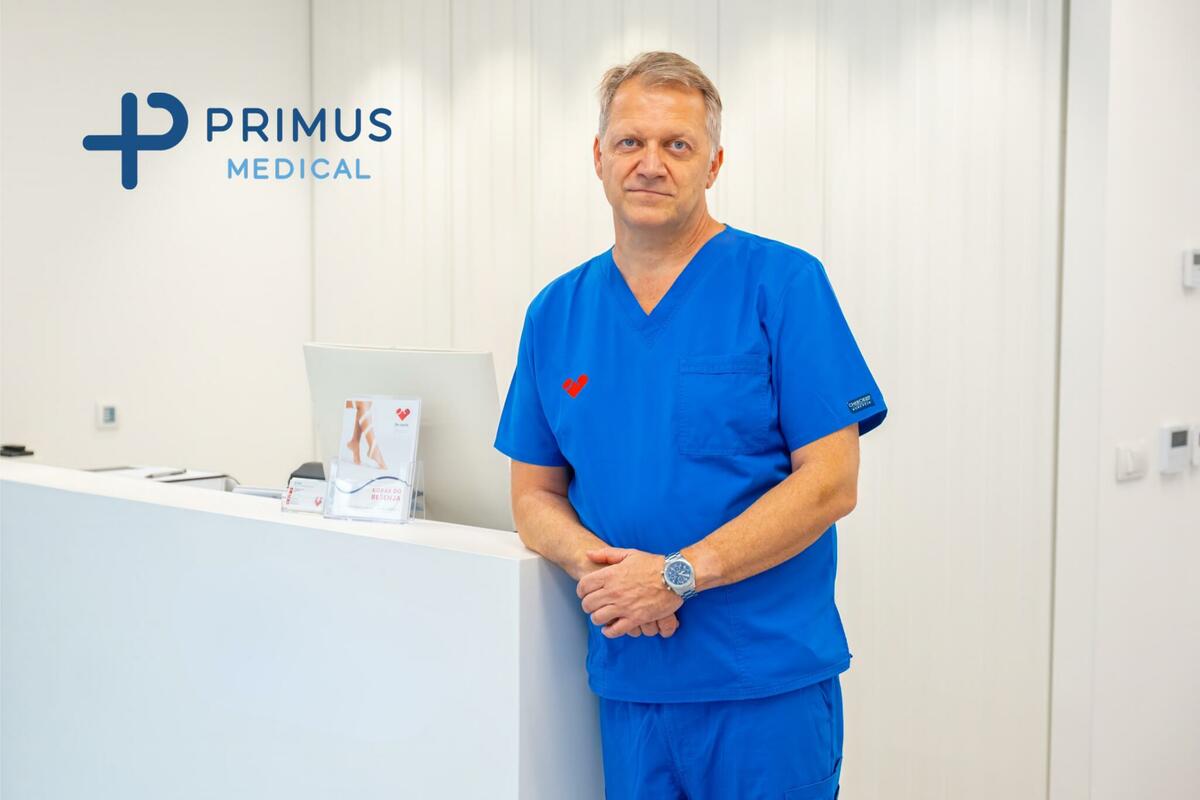
“The biggest misconception is that laser surgery doesn’t help severe vein problems – the truth is quite the opposite.” – emphasizes Dr. Dario Jocić, vascular surgeon and leading expert in the area in the field laser vein treatmentFor more than 10 years of working in the clinic Primus Medical in Podgorica, Dr. Jocić has performed thousands of successful laser operations, definitively resolving some of the most complex cases of venous disease.
What are the most common misconceptions people have about laser vein surgery?
Many believe that the operation is painful, difficult and requires a long recovery. In fact, it is a minimally invasive procedure, the patient is awake, there are no incisions or scars, and after 20 minutes after the procedure, he can walk completely normally. The laser is currently the gold standard in vein treatment, because it gives the best short-term and long-term results.
What does laser surgery look like?
Laser vein surgery involves virtually no incisions – only very small punctures. The procedure is performed under local anesthesia, which allows the patient to stand up and walk immediately after the operation. This avoids the risks associated with general anesthesia.
“The procedure is done under local anesthesia — the patient is awake and pain-free”
The procedure on both legs takes about an hour. When we operate on just one leg, it usually takes about forty minutes. I always tell patients, “Once you come in, we can fix the problem in 40 minutes to an hour, and that’s practically all that’s required of you.”
After the procedure, it is recommended to wear compression stockings for two weeks, as well as mandatory walks immediately after the operation — especially the first two to three days, when it is desirable to move a little more. After this, patients return very quickly to their usual life and work activities.
Is laser surgery appropriate for all varicose vein patients, even those with trauma?
Even patients who have venous ulcers or severely enlarged veins may be candidates for laser surgery. For them, laser surgery is often the best and most effective option, especially in the most serious and complex cases. Patients with venous ulcers are very difficult to operate with classical, conventional surgery. The reason is simple: every long-lasting wound contains certain bacteria. If we make an incision during the classic operation, there is a high risk of infection.
With laser surgery, this risk is practically non-existent. The procedure is short, minimally invasive and therefore patients with venous ulcers are absolutely suitable for this type of operation.
For patients with larger nodules or highly complex findings – laser surgery remains an option. In essence, there is no finding that is “too complicated” for this method. The only important question is whether the patient really needs surgery or not. If so, laser surgery is the safest and most effective option. If the patient is not a candidate for laser surgery, they are not a candidate for conventional surgery.
“Both extremely large veins and venous ulcers can be successfully treated with laser”
Can diabetes or high blood pressure delay surgery or affect the ability to perform the procedure?
Diabetes itself is not a contraindication for laser vein surgery. In laser surgery, everything is done under local anesthesia, which is significantly easier and safer for patients with co-morbidities. Of course, the general health of the patient is taken into account — if the patient has additional treatment, the doctor consults with other specialists and the treatment is adjusted as needed.
Laser vein surgery is considered suitable for older patients and those with chronic conditions because it is a procedure performed under local anesthesia. The patient returns to normal activities very quickly, and seniors often ask, “Can I handle it?”
“If you can cook lunch or go to the store — you can do this process.” Recovery is easy and quick.”
When can patients who work “on their feet” return to work — hairdressers, cooks, waiters?
These are the most common patient groups. For such professions, it is usually recommended to return to work after 5-7 days. The most important thing during the recovery period is walking – the emphasis is on movement, not standing still or lying down. The key to successful recovery is for the patient not to stand for long periods of time, not to lie down, but to move and walk moderately. Sick leave is generally not necessary.
What will happen if varicose veins are not treated in time?
Untreated varicose veins can lead to serious complications of vein disease. The most common is thrombophlebitis – the formation of blood clots in the superficial veins. It is usually unpleasant and painful, but most of the time it is not dangerous as long as the clot remains in the superficial system. The problem arises if the clot spreads to the deep veins, because then it can represent a serious health condition. Untreated veins lead to chronic changes in the skin. Some of these changes are irreversible and even after surgery, permanent hyperpigmentation or scarring may remain. There are also venous ulcers – a serious, long-term and persistent complication that significantly reduces the quality of life.
Can varicose veins reappear after surgery?
Varicose veins are successfully treated with surgery, but like any disease — there is a chance of relapse or recurrence. However, it is important to emphasize a few things. The new veins do not appear in the same place, but in other parts of the venous system. Regular check-ups are key — patients who come in for a check-up once a year or as soon as they notice a change have a much better long-term outcome. If the problem is detected early, it can usually be solved very easily, without the need for repeated laser surgery.
“Veins do not return – the disease returns if not treated in time”
Primus Medical is the leading clinic in terms of the number of minimally invasive vein procedures in Montenegro. The combination of a leading surgeon, advanced technology and a modern approach to treatment make it the clinic most trusted by patients when it comes to the treatment of venous diseases. Dr. Dario Jocić will return to action on December 19, 20, 21 and 22. Find out more and book your appointment for a specialized examination that includes blood vessel doppler – by calling 063 21 31 21.
Primus Medical
Bulevar Pera Cetkovica 61, Podgorica
📞 +382 63 213 121
(Primus Medical)
( Promotional Content )
