


From medical devices and building materials to ceramic artwork, 3D printing technology is expanding its footprint across all industries in China, accelerating its integration into production and daily life, while boosting economic growth and public welfare.
In a consultation room at Peking University Hospital of Dentistry, a patient asked questions about a treatment option. Dentist Sun Yuchun held up a veneer sample and explained, “This zirconia veneer is only 80 micrometers thick. Using it to restore teeth requires virtually no grinding, greatly reducing the damage to tooth enamel.”
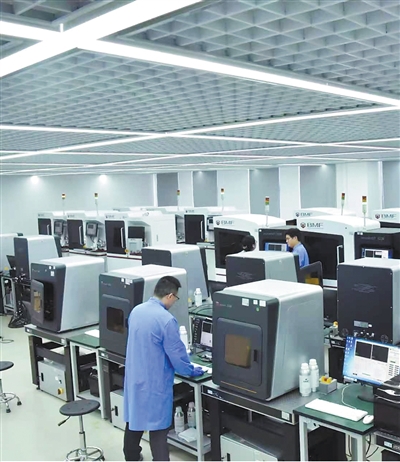
“Traditional machining could only produce veneers 300 micrometers thick,” said Yang Fei, vice president of BMF Precision Tech Inc. in southwest China’s Chongqing Municipality. The company has leveraged 3D printing technology to dramatically reduce the thickness of the veneer.
Photo shows BMF Precision Tech Inc.’s 3D printing center. in Liangjiang New District, Chongqing Municipality, Southwest China. (Photo courtesy of interviewee)
In 2021, BMF Precision Tech established a joint laboratory with Peking University Hospital of Dentistry to develop 3D-printed dental veneers, a project later approved as important under national key research and development (R&D) programs during the 14th Five-Year Plan period (2021-2025).
After more than 1,000 tests, the hospital finally “printed” ultra-thin veneers it had long sought but been unable to produce, achieving little or even no restoration grinding, said Liu Yunsong, director of the prosthetics department at Peking University Hospital of Dentistry.
The thriving advanced materials industry cluster in Chongqing’s Liangjiang New Area has provided critical support for bringing 3D-printed medical devices to market.
“More than 100 dental hospitals and clinics nationwide have adopted this product, and in 2025 we have exported over 10,000 pieces of veneer materials abroad,” Yang said.
In the treatment of thrombosis, 3D-printed spiral magnetic robots just 2.15 millimeters in diameter can autonomously navigate blood vessels to reach sites of clots. For the treatment of glaucoma, 3D printed drainage devices can greatly simplify traditional surgeries. Today, 3D printing technology continues to unlock new possibilities in the medical field.
In Xiong’an New District in northern China’s Hebei Province, a new cultural landmark is rising with the help of large-scale 3D printers.
The cultural center, known as Xiong’an Wings, features giant curved surfaces that look like herons in flight. The structure draws inspiration from classical Chinese poetry that depicts a heron gliding over misty water.
As one of China’s largest 3D-printed buildings, the cultural center demonstrates the advantages of new quality production forces.
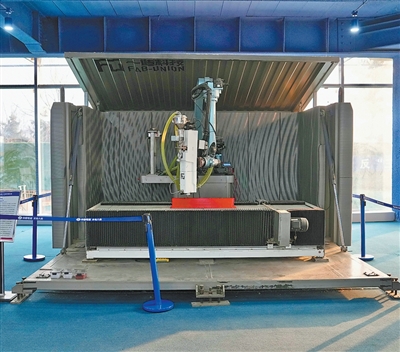
A 3D printer operates in a “capsule factory” on the ground floor of the main building of Xiong’an Wings, a cultural landmark in Xiong’an New Area, north China’s Hebei Province. (Photo/Zhao Weitong)
“Its unique design was difficult to realize using traditional construction methods,” said Zhao Yiqing, cultural center architect at Tongji Architectural Design (Group) Co., Ltd.
As such, the project uses 3D-printed components to construct the double-curved facade, achieving complex geometry while faithfully implementing the design vision, Zhao noted.
Some of these components come from a “capsule factory” on the ground floor of the main building. There, a massive 3D printer with a robotic arm operates around the clock, producing parts for immediate field use.
“The printer uses modified plastic as its main material, producing parts with double-curve hollow structures,” said Meng Yuan, chief engineer at Shanghai Fab-Union Technology Co., Ltd., the project’s 3D printing technical consultant. Meng added that multiple 3D printers are running simultaneously at the company’s Shanghai production base. The project required more than 4,000 components, each unique in size and curvature.
“It’s worth noting that the modified plastic used in 3D-printed parts is recyclable, making it environmentally friendly,” Meng said. Selected as a demonstration project under national key R&D programs during the 14th Five-Year Plan period, Xiong’an Wings is scheduled to be completed this September. It will not only serve as a model for smart and green construction, but also bring significant benefits to public cultural life.
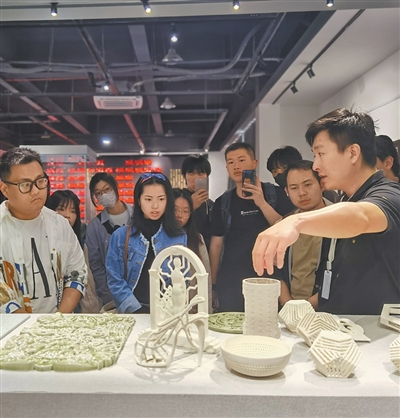
An employee of Micro Ceramic Technology (Jiangxi) Co., Ltd. presents 3D printed ceramic products to visitors in Jingdezhen, East China’s Jiangxi Province. (Photo courtesy of interviewee)
In Jingdezhen, East China’s Jiangxi Province, the showroom of Micro Ceramic Technology (Jiangxi) Co., Ltd. presents a wide range of 3D printed ceramic products, including fashion accessories and fashion dolls.
The technology has unlocked new opportunities to create higher-value ceramic art, said Huang Wancheng, the company’s general manager.
Traditional ceramic production requires casting, with minimum orders typically ranging from 200 to 300 pieces. In contrast, 3D printing allows immediate production without molds. This allows ceramic designers to quickly turn creative ideas into physical products at a lower cost for market testing, thereby enhancing market flexibility and responsiveness.
The company operates a permanent practical training and employment base for Jingdezhen Ceramic University and cooperates with institutions such as the Central Academy of Fine Arts and the China Academy of Art in research exchanges and joint creative projects, acting as an active link for industry-academic and research integration.
“We regularly open our facilities to academics and students for visits and host technical lectures. We also provide prototyping services to support their research projects,” said Huang.
This close collaboration allows future ceramic designers to gain early familiarity with digital fabrication tools, helping transform creative ideas into tangible products while expanding the application boundaries of ceramics, Huang added.
(Web Editor: Chang Sha, Liang Jun)
