


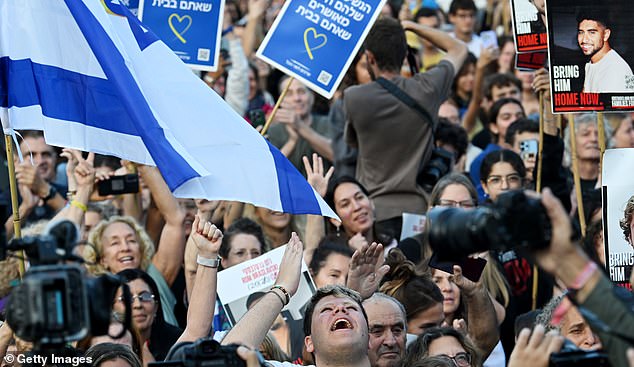
Tears of relief flowed freely among my family members, scattered around the world from Texas to Tel Aviv, Sydney to London, as the 20 Israeli hostages who are still alive were freed from the evil hands yesterday.
Of course, the anguish for the captives, their families and their loved ones was unimaginable.
But the 738 days spent in captivity following the atrocities of October 7, when 1,200 Israelis were mercilessly slaughtered as they went about their daily lives, were excruciating and painful for Jews around the world.
Because in a twisted reversal of morality, the horrific fate of those who died, the mutilation and abuse of women during the massacre, and the desperate plight of the hostages seem to have been largely forgotten over the past two years.
Instead, we have seen an orgy of anti-Semitism on Britain’s streets, in capital cities and on university campuses everywhere.
A synagogue was set on fire and destroyed in Melbourne. In cities across the West, children were told by their families not to reveal that they were Jewish. Just a fortnight ago, innocent Jews were murdered in Manchester.
And yet the anti-Zionist demonstrations – demonstrations where support for the outlawed terrorist group Hamas was overwhelmingly evident – were endless. What happened to compassion? Did the protesters who declared their support for the perpetrators of the evils of October 7 never stop thinking about those who were massacred and raped by Hamas, those trapped in tunnels, or their families and dear friends?
Sometimes it seemed that the only people who expressed concern for the victims of this atrocity were my people, the Jewish people.
Supporters react with joy as they watch a live stream of the prisoners being freed in Homer Square in Tel Aviv
Every day in Jewish communities around the world, prayers are quietly recited in synagogue for the captives, in the hope that they would return safely.
In private dedications, my own thoughts were with Alon Ohel, 24, the talented classical pianist who, during his chained captivity in the Gaza tunnels, learned fluent Arabic by listening to his captors.
Earlier this year I visited Ohel’s family in their elegant home in the Galil Hills of northern Israel, overlooking Lake Tiberias, otherwise known as the Sea of Galilee.
I learned about his life as a prisoner – the information had been gleaned from other hostages who had been returned. I was told how this brilliant concert performer, arrested at the Nova festival, had been blinded by a shrapnel wound in one eye.
The family home was a shrine in his life and recordings of his refined playing echoed on these hallowed hills.
Yesterday, finally released from prison, he played the piano for the first time in two years in his Tel Aviv hospital room.
But even as the last surviving hostages were reunited with their families in unvarnished scenes of joy, it was impossible to forget the anguish of those whose loved ones would never return alive. For Jews, the purity of the remains of the dead is of prime importance. Returning the bodies of dead hostages for interment in blessed ground is a sacred and moral responsibility.
Just as it was a moral duty among countless numbers of the Jewish community to pray for an end to the cruel fate suffered during the war by the Palestinian residents of Gaza. Who could not be disturbed by the assault on humanity by the Israel Defense Forces campaign? The loss of life and limb, the suffering of young children and the struggle for survival against a backdrop of shortages of food, medicine, water and electricity was heartbreaking.
But what was also troubling was the lack of any attempt by Israel’s critics to put it in context. Israel was fighting a war in which the enemy, Hamas, was embedded in 350 to 450 miles of tunnels under Gaza, under all major hospitals and many schools. It was a strategic challenge beyond anything in modern combat.
If anything, it was Hamas, paid and armed by the ayatollahs of Iran, that had endangered ordinary Palestinians.
But Israel was blamed most of the time. The speed with which the narrative of the worst atrocity for the Jewish people since the Holocaust was usurped by hatemongers, by a broadcaster that should know better and by the UN and politicians such as the then Labor foreign secretary David Lammy – who declared Israel’s actions in Gaza “intolerable” – was shameful.
These critics appeared to embrace Hamas’ data, publishing Hamas statements, video clips and information as if it were all gospel truth, rather than propaganda in the fog of war.
Some suggest that Israel, by declaring all-out war on Hamas and other radical Iranian-backed terrorists throughout the Middle East, has fallen into a trap set by the terrorists. I am simply asking what would be the reaction of the western democracies, USA, Britain, France and others, if 1,200 of their citizens had been massacred and 251 hostages had been taken. Would they have stood by them? Would they have acceded to the demands of hate protesters and critics of Israel and allowed the outlawed terrorist organization Hamas to continue to flourish? Wipe their own country off the map?
Of course, the Jewish community was not without supporters. It was a great comfort to me, when the feelings of the hostages and the Jews seemed to be erased, to see every day in the Daily Mail office a notice board behind the editor’s desk with a simple message about the hostages: “Bring them home.”
But the past two years have been a profoundly upsetting experience. So many people – with the encouragement of the broadcast media – managed to convince themselves that the events after October 7 were only about the fate of the citizens of Gaza rather than the eradication of terrorism.
So much inflamed anti-Semitism has come to light because of Israel’s legitimate attempt to defeat a ruthless, bloody, murderous hostage-taking group with ideas that are anathema to normal, Western, moral sensibilities.
As the details of Donald Trump’s peace initiative became clear late last week, I turned on Sky News. Without preamble or reservation, the program’s interviewer asked a senior Hamas official about the peace deal, the future of Palestine and what’s next for his organization.
The answers were clear: the cause was not dead and disarming his paratroopers was a dream.
It was completely disturbing. A spokesman for a banned terrorist organization, dedicated to the elimination of Israel, was treated as a reliable interlocutor whose words could be trusted and taken with the same seriousness as longtime Middle East analysts.
The hostages may be home, but the veneer of respectability given to the October 7 fanatics and their unruly successors remains a tender, open wound.
