


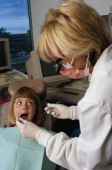
Options for children now include sealants and early wisdom teeth removal.
(HealthDay) — If you’ve been to the dentist with your kids recently, you may have noticed that things have changed since you were a kid.
Many dental offices are more kid-friendly these days, offering books and toys to pass the time in the waiting room and maybe even a TV or video to watch while they have dental work.
But, there have also been changes in the actual practice of pediatric dentistry. You probably never had dental sealants as a child or topical fluoride treatments. If you had your wisdom teeth removed, it was more than likely because they were causing a problem, but today those teeth may come out earlier to reduce the risk of complications.
Here’s a sampling of what’s new in pediatric dentistry:
Dental sealants
Many teeth have rough surfaces that are difficult to clean. When applied to these surfaces, a dental sealant makes the pitted and pitted area of the tooth smooth and easy to clean.
“The back teeth have a biting surface and fissures that are difficult to clean,” said Dr. Larry Kronenberg, a pediatric dentist with North Westchester Hospital in Mount Kisco, New York. on the tooth and cause cavities”.
“If your child has shallow cracks, sealants are probably not indicated,” she said. “But if you’ve ever given your child a cookie and later found that the food was still stuck to the teeth, your child could benefit from sealants.”
Sealants are easy to apply. The dentist brushes them against the teeth and the sealant bonds to the tooth enamel, according to the American Dental Association (ADA). A curing light is sometimes used to help sealers dry faster.
Fluoride treatments
“Ingested fluoride works on teeth that are not yet in the mouth, those that are not yet erupted, but it has no effect on teeth that are already in the mouth,” Kronenberg said. “A fluoride treatment using a gel or varnish embeds the fluoride on the surface of the outer layer of the tooth. It has to be repeated because it wears away.”
Fluoride is applied using a swab or brush or placed in a tray that the child bites down on and then holds in the mouth for several minutes. Once a fluoride treatment is done, there should be no food or drink for 30 minutes to allow the fluoride to absorb into the teeth, according to the ADA.
Kronenberg explained that the difference between fluoride in toothpaste and fluoride treatments is the concentration. The fluoride in toothpaste is much less concentrated, he noted.
Guardians
Should they stay or should they go? This is the question that children and parents face.
Kronenberg said most dentists start looking at a child’s wisdom teeth around age 16 or 17 to see if there is room for the teeth to come in properly without causing problems. If a tooth looks like it won’t go in properly, some dentists now recommend removing those teeth sooner rather than later to make removal easier. The less chance the tooth has to grow, the shallower the roots will be, Kronenberg explained.
But not everyone practices early abstraction.
“There is no protocol that says all wisdom teeth have to be extracted,” said Dr. Joshua Verona of the department of dentistry at Beth Israel Medical Center in New York. “If they don’t affect function or appearance, we just leave them in. We only extract wisdom teeth when they’re symptomatic.”
Parents should discuss with their family dentist the risks and benefits associated with leaving wisdom teeth or removing them.
Stress reduction
Kronenberg said pediatric dentists are seeing patients at younger and younger ages. Some recommend that dental visits, like well-child visits to the pediatrician, begin at age 1 so that dentists can discuss the importance of nutrition and oral hygiene with parents. But more importantly, he said, early visits “help start a relationship between the child and the dentist at a young age, and generally, if you’ve established a positive relationship, children are more willing to accept necessary treatments in the future.”
More information:
The Nemours Foundation KidsHealth website has more good oral hygiene.
An accompanying article recounts changes in pediatric dentistry from one generation to another.
Copyright © 2012 Health Day. All rights reserved.
Reference: Tiny kids in the dentist’s chair amid changes in pediatric dentistry (2012, May 18) Retrieved January 11, 2024, from
This document is subject to copyright. Except for any fair dealing for purposes of private study or research, no part may be reproduced without written permission. Content is provided for informational purposes only.
