


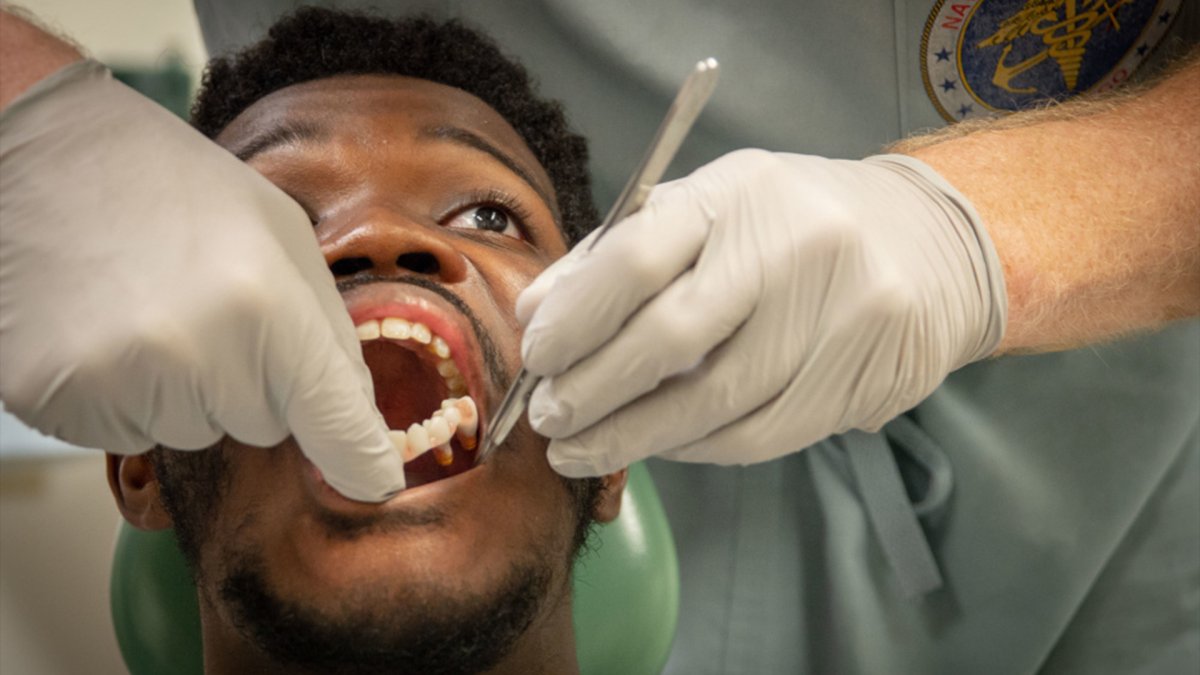
A lucky Marine made military medical history by becoming the first soldier to receive a reconstructed jaw made from one of his leg bones, complete with 3D printed teeth, all in one operation.
Lance Cpl. Jaden Murry, assigned to Combat Logistics Battalion 7 at Marine Corps Air Ground Combat Center, Twentynine Palms, Calif., was diagnosed with an aggressive but benign tumor in his lower jaw about a year ago. Normally, it would take multiple surgeries and years of recovery to come back from this, but new techniques and technology mean Murry will be back on duty after just one operation and a few months of recovery.
“In terms of actual downtime away from his unit, we expect Murry to be out for eight to 10 weeks, compared to years with previous recovery techniques,” said Lt. Adm. Daniel Hammer, the surgeon who performed the procedure at Naval Medical Center San Diego on Nov. 18, according to a recent press release. “That’s a small amount of time compared to the size of the process.”
The procedure is truly incredible as it involved two surgeries at the same time. One surgical team worked to remove Murry’s tumor-stricken lower jaw while another cut out a portion of the Marine’s fibula, the smaller of the two bones in the lower leg, and reshaped it to form a replacement lower jaw.
“Basically, I’m going to assemble a new lower jaw while the bone is still getting blood from the leg,” Hammer said in a Nov. press release before surgery. “We will then remove it completely and transplant it into ready and waiting blood vessels in the head and neck, specifically branches of the carotid and jugular veins.”
The sutures they used to connect the new jaw to the existing blood vessels in the head and neck are about half the thickness of a human hair, Hammer explained.
Reshaping a leg bone into a jaw is crazy enough, but the surgery was also unique in that surgeons crowned the new jaw with 3D-printed teeth designed right there at NMCSD. Even more amazingly, surgeons left enough of Murry’s fibula in his leg so that once he fully recovers he will have no restrictions on movement and exercise.
“He’s a young Marine,” Hammer said. “[The ability to] Exercise and movement are huge for his readiness, recovery and morale.’
The process is the first of its kind in California and the Department of Defense and is one of the first in the US. But why was it necessary to harvest the fibula and remove the lower jaw at the same time? Hammer explained that it was a safer and more effective option: the longer a patient spends under anesthesia, the greater the chance of complications, he said. Additionally, fewer surgeries mean Murry has more time to recover and fewer injuries to recover from.
“Through working with multiple surgeons and the knowledge I gain in my training, we can forever change a person’s life for the better in just one day,” Hammer said. “In terms of psychosocial damage and military readiness, there is no doubt that the immediate jaw restoration procedure is superior in every way to the outdated approach.”
Video: Army medics compete for Expert Field medic badge
It also helps to have a patient in a great mood. Murry said he never felt too nervous because he trusted the hands of his surgical team.
“Even though I hadn’t been in a hospital since I was three, I knew I was in good hands,” the Marine said. “I had to put all my faith and hopes in the hands of strangers. I had to trust them all.”
He also relied on his mother and grandfather to ask insightful questions about the procedure and keep him calm throughout.
“My mother called [NMCSD surgeon Lt. Justine Odette] with questions I wouldn’t have thought to ask, and my grandfather assured me everything was going to be okay,” Murry said. “It calmed me down and put my mind at ease. [Odette] and Dr. Hamer were very good at relaying information to me and my family.”
The surgery took place on November 18, and Murry’s recovery has been smooth sailing ever since. Within a week of the surgery, the team removed his tracheostomy tube, which is placed in a hole in the patient’s throat to allow breathing. Soon after, the Marine passed a swallow test and returned to talking and eating without a feeding tube.
“To see him swallowing, talking, walking and not using a tracheostomy tube a week after surgery was a huge victory, both for [Murry] and for us,” Hammer said. “Even with a brand new lower jaw, we were so confident in his ability to swallow, we removed his feeding tube right after [Murry] passed the study of the swallow.’
Of course, just because Murry is healing quickly doesn’t mean it was easy.
“The first two weeks were difficult and I was in a lot of pain,” she said. “I’ve been on a bland diet of chicken noodle soup, baked beans and ramen noodles. I’m looking forward to getting back into a healthy mindset and exercising, running and building my body.
“Everything is going to heal, and healing is a process that won’t last forever,” he added.

Hammer credited his military medical training and the other medical professionals on the NMCSD team for making the procedure go smoothly. Other doctors include Odette, one of the directors of Oral and Maxillofacial Surgery (OMFS) in the NMCSD Department of Dentistry; Cmdr. Yu Zhang, a maxillofacial prosthetist assigned to NMCSD. Capt. Craig Salt, Cmdrs. Eamon O’Reilly and Yan Ortiz from Plastic Surgery. and Cmdr. Patrick Morrell, who led one of the surgical teams tasked with removing the patient’s lower jaw. Murry also received assistance from NMCSD’s Intensive Care Unit, Physical and Occupational Therapy, Speech-Language Pathology, Respiratory Therapy, Clinical Nutrition, Social Work and Nursing teams.
The Marine will still have regular checkups to make sure the new teeth are in good shape and the new bone is fully integrated into the jaw. But if all goes as expected, he’ll be fully healed, unrestricted, and able to do solid food within six months.
When that happens, Murry said, pizza is definitely on the menu.
Related: First Wounded Combat Veteran to Get Penile Transplant Shares His Story: ‘It Was One of the Best Decisions I Ever Made’

Video Task & Purpose
