



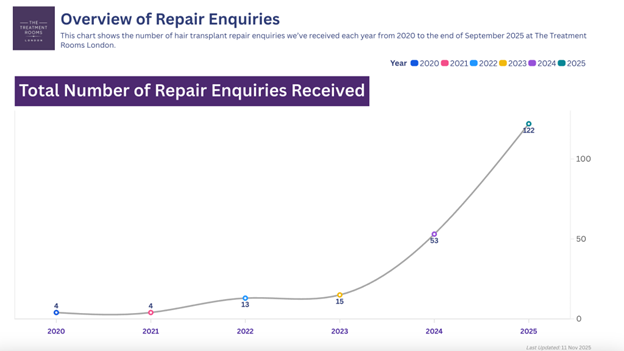
The rise of low-cost, high-volume hair transplant tourism has caused an increase in patients suffering complications, and London is now seeing the consequences. According to new internal data, The Treatment Rooms London, one of the UK’s leading surgeon-led hair transplant clinicssaw a 43% increase in hair transplant repair cases in 2025, with an average of 1.8 repair requests each week.
These cases usually involve men who traveled abroad for discounted procedures, only to return with damaged donor areas, unnatural hairlines, scarring or poor growth, complications that often require corrective surgery by specialists.
The increase highlights a major shift in the industry: more patients are realizing the long-term costs of procedures done incorrectly and are now turning to regulated UK clinics for help.
A worrying trend: More patients are returning with serious complications
The clinic’s surgery repair program, known for supporting patients affected by unregulated clinics, has seen its biggest rise since it began.
According to the clinic’s surgeons, the majority of cases fall into several recurring categories:
- Overharvested donor lands
- Puffy, low or unnatural hair
- Visible scars from outdated tools
- Incorrect graft angulation or direction
- Sparse density or failed graft survival
- Infections or medical complications after surgery by non-medical personnel
These patterns closely align with the warning signs described in the clinic Free hair transplant repair surgery page, which has become a resource for patients seeking clarity after negative experiences abroad.
“Many of these patients were promised ‘guaranteed results’ for a low fee.” he says Dr. Roshan Vara.
“But when surgeries are performed by technicians instead of surgeons, the risk of permanent damage increases dramatically.”
Why Hair Transplant Tourism Fuels Repair Cases
Although hair transplant tourism has been popular for years, patients are now discovering the hidden dangers — often too late.
Several factors contribute to the increase in correctional cases:
1. Surgical procedures performed by non-medical technicians
Many clinics abroad use unlicensed technicians to perform critical parts of the surgery. This is illegal in the UK but common abroad.
2. High Volume “Production Line” Clinics.
Patients are often processed quickly, with little attention to long-term donor preservation or physical design.
3. Unrealistic promises and misleading advertising
Sales teams, rather than surgeons, handle consultations, leading to unrealistic expectations and aggressive marketing.
4. Lack of aftercare
Once the patient flies home, support becomes limited or non-existent, leaving complications unmanageable.
5. Bad management of the sponsor area
Excessive extraction can permanently limit the patient’s future treatment options.
This combination results in long-term damage that only an expert repair surgeon can address.
A 43% increase in repairs shows the dark side of the industry
While the rise in repair cases demonstrates strong confidence in UK surgeon-led clinics, it also exposes a worrying trend:
The global “black market” in hair transplants continues to grow.
Some alarming findings include:
- Many patients did not know that their operation was performed by technicians.
- Some clinics harvested 4,000–6,000 grafts from donors who could safely support only 1,500–2,000.
- Many patients received identical, pattern-type hairlines regardless of age or ethnicity.
- The patterns of the scars reveal the use of antiquated tools that are still common abroad.
According to Dr. Dylan Fernando:
“Reconstructive surgery is emotionally sensitive. Patients already feel let down or misled, so they need honesty and a safe, long-term plan, not another quick fix.”This lack of regulation highlights the importance of choosing a CQC registered UK clinic with GMC registered surgeons.
Why more patients are opting for reconstructive surgery in the UK in 2025
Several factors explain why repair requests have increased so sharply:
1. Growing awareness of false results
Social media is full of men sharing their negative experiences abroad — raising awareness of the dangers.
2. More realistic expectations
Consumers now understand that “cheap” hair transplants can cost much more in the long run.
3. Increased confidence in UK regulations
CQC oversight, GMC-registered surgeons and strict surgical rules offer greater reassurance.
4. Improved repair techniques
Advances in FUE allow better restoration of damaged donor areas and abnormal hairs.
5. Free Clinic Repair Initiative
The Treatment Rooms London is one of the few clinics in the UK to offer eatree or subsidized reconstructive surgery for eligible cases, which has caught the attention of patients in 2025.
What this wave means for the industry
A 43% increase in repair requests isn’t just a statistic – it’s a warning.
It indicates:
- increasing harm from unregulated clinics
- increased long-term donor damage
- Greater demand for UK expertise
- The need to raise public awareness about safe surgery
London Treatment Rooms are now playing a key role in tackling this damage — not just restoring hair, but restoring patient confidence, trust and safety.
Final Thoughts
The growing number of repair cases in 2025 reflects both the risks of hair transplant tourism and the importance of choosing a safe, regulated, surgeon-led clinic.
With an average of 1.8 repair requests per week and a 43% year-on-year increase, The Treatment Rooms London has become a trusted center for corrective surgery, providing hope, clarity and long-term solutions to patients disappointed elsewhere.
This increase is a reminder that hair transplantation is not just a cosmetic procedure. it is a medical surgery that requires expertise, safety and ethical care. And when things go wrong, the cost isn’t just financial. it is emotional and permanent.
For patients seeking rehabilitation after a negative experience, surgeon-led repair remains the safest way forward, and 2025 has proven how vital this work is.
